
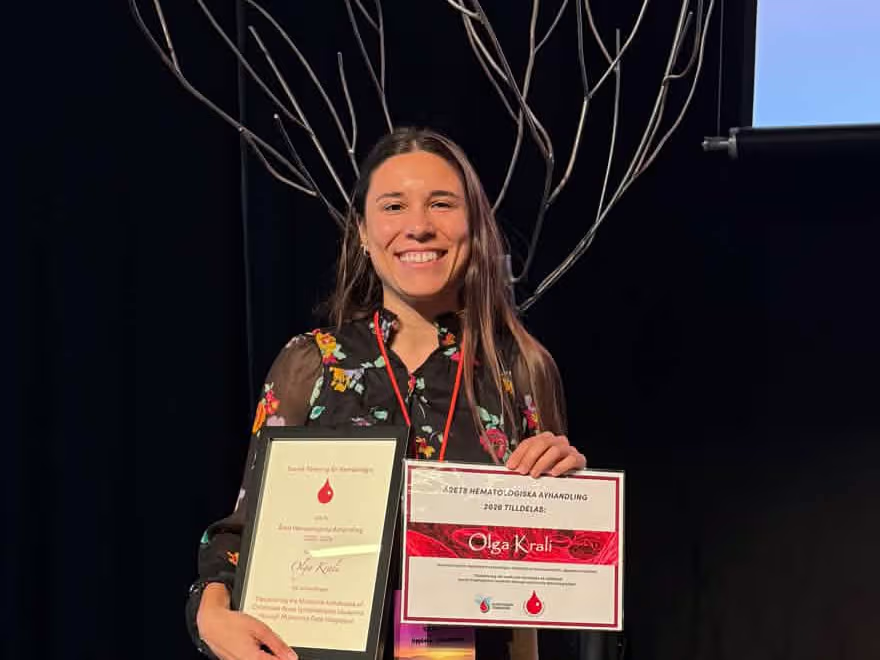
From plants and ecology to machine learning and cancer research, and from there to the shooting stars of science fiction. 5 Stigmes welcomed Olga Krali, postdoctoral researcher at Uppsala University and novelist, and asked her 5 questions about scientific research and another 5 about writing.
Olga studied Biology at the University of Patras, but her path led her from the world of plants and ecology to Machine Learning and biomedical research. Today, as a postdoctoral researcher at Uppsala University in Sweden, she develops diagnostic and prognostic models for cancer, drawing on data and artificial intelligence to better understand the disease and advance treatment strategies. In her free time Olga writes science-fiction novels with romantic elements, letting her structured thinking come apart in another dimension.
Part 1
Scientific research
Question 1
What led you into scientific research, and how did your interest in serious diseases come about?
Olga
Our Geography teacher in junior high told us that if we did well in his test, he would take us with him to the Pharmaceutical Chemistry conference. That is where I met the first scientists who made me admire their work and their contribution, and they became a kind of guide for the next steps of my life. My interest in serious diseases appeared at two very important crossroads. The first time I was a small child and saw another sick child in hospital. I asked my mother what was wrong with him and, although I did not understand what cancer meant, I did not like the sound of it. Later, in my final year of high school, my mother fell ill with cancer, and I took it even more personally.
Question 2
With your experience of scientific research, how would you compare the conditions in Greece with those in Sweden? Which differences do you consider most important, and what would you like to see change in Greece?
Olga
The truth is that I cannot make a direct comparison, since I have been in Sweden for the last 12 years and have never worked in research in Greece. What I can do is share some experiences that have had a positive effect on me and probably on many of my colleagues.
The culture of collaboration between research groups is very widespread, and I believe it contributes significantly to scientific progress. I also appreciate the trust placed in young researchers and the encouragement of independent thinking, which is expressed in practice through awards, financial support for attending scientific conferences, and funding opportunities for the first steps of a postdoctoral career. At the same time, importance is given to the balance between professional and personal life, which gives us the chance to develop other sides of ourselves.
I do not know to what extent these characteristics exist in Greece, but I consider them very important elements of a healthy and creative research environment.
Question 3
What is the biggest challenge you have faced in your research career, and what helps you keep going when results do not come easily?
Olga
One of my biggest challenges is that I often need to start an analysis from scratch. I have had to rebuild my computational models, for example, which means revising the results, the figures and the text. But research moves forward through trial, error and constant re-evaluation.
Something I often say is that data have a story to tell. If we are not finding what we are looking for, perhaps we need to approach the problem with a different method. On the other hand, I remember something our professors used to tell us: even negative results are still results. What I find fascinating about biology is the effort to understand why we observe a particular result, even when it differs from what other studies have found.
Question 4
How does the thought that your research could help improve human life affect your work?
Olga
Although the distance between a scientific discovery and its clinical application is great, the thought of our small contribution to improving patients' lives is a driving force.
Question 5
Which development in research on serious diseases would you most like to see become reality in the coming years, and how do you think it could change patients' lives?
Olga
The use of artificial intelligence in the biomedical sciences began many years before the recent spread of large language models. Still, the progress we are seeing today is particularly fast. One development I would like to see is the wider integration of reliable artificial-intelligence models into clinical practice, to support medical decisions.
Although this sounds like a simple undertaking, every disease has its own particularities, and developing such models requires careful design and extensive evaluation to ensure their reliability and clinical usefulness.
Faster and more accurate diagnosis or prognosis of a disease can contribute to treating it in time. At the same time, a better understanding of a patient's molecular background could help in choosing personalised treatments, limiting side effects and improving both survival and quality of life.
Part 2
Writing and science fiction
Question 1
When did you start writing, and what made you choose science fiction?
Olga
I started writing two years ago, when I read the book Mindset. I used to struggle with literary texts, and I read the book's message as a challenge to develop a new skill through constant repetition. Science fiction was a one-way street, since I have a great love for the universe and its unanswered questions.
Question 2
Where do you draw inspiration for your stories, and how does an initial idea evolve into a book?
Olga
The first book came as a story that helped me fall asleep on the nights when I struggled to. But I can say that, even with an initial idea, the story changed a great deal. I recently discovered the different kinds of writers, and I think I belong to the category of discovery writers. I take a notebook and simply let the pencil become my voice. Over time the characters take on their own shape, and I learn their path as if I were an observer. Then I transfer the text to the computer, where I make the first changes and language corrections, complemented by the comments of a close circle of readers. The book keeps evolving with the feedback I receive from literary agents, whom I contact for representation.
Question 3
How much does being a scientist influence the way you write science fiction? Are there elements of real science that you weave into your stories?
Olga
A big smile formed on my lips here. I would say that my background influences my stories to a great extent, and it is my signature. Anything related to the environment, plants, animals, medical research, machine-learning models or the biology of the brain can make an appearance in the stories. The main characters are scientists who also discover life through the eyes of another civilisation.
Question 4
What is the biggest challenge you face when writing a book, and what helps you get past the moments when inspiration or creativity does not come easily?
Olga
My biggest challenge when writing a book is language. Apart from the fact that English is not my mother tongue, I have learned to write scientific texts, and that shows in my books too. At some moments it is necessary, but at others I have to tone it down so that the story does not read like a university lecture. I mention this because my books are soft sci-fi with pieces of romance, which calls for a different language.
When my inspiration runs dry, I go next to some body of water, a lake or the sea, and look at the water. My stories are connected to it, and it helps me find my way.
Question 5
What would you like readers to keep from your books, and what thought would you like to stay with them after they finish reading?
Olga
I would like every reader to be able to find a refuge in these stories and to discover the hidden, as well as the obvious, messages that will help them start making wishes on shooting stars again. And my own dream as a writer is not yet complete, but I never stop chasing it.